Crab

A gamified experience for assessing children's learning abilities.

Project overview

Problems

Students' reading capabilities are usually assessed through paper-based protocols. These processes require the presence of an experimenter and they're boring (for the child). In addition, a manual transcription of the results is needed. How could we improve this assessment methodology?

Methods

Wireframes;

design system;

prototype.

Tools

Figma;

After Effects.

Goals

Designing a high fidelity prototype of an application concerning gamified assessment of children's reading capabilities.

Developed in collaboration with Martina De Cet, Luca Santoro and Nicolò Veronese (2021).
Introduction

Crab is a mobile application prototype designed for children.

The aim of this prototype is to explore a potential gamified version of traditional assessments for learning abilities.

In particular, the experiment concerns in words and pseudo-words decoding in children. The interaction is structured in such a way that the desired target group can participate in and enjoy the assessment thanks to a gamificational approach.

The solution was designed for Italian speakers and the prototype is completely in Italian.

Design process

1

Literature review

2

Prototype

3

Tutorial definition

The problem

Performing experimental tests with children is not an easy task, neither for the experimenter nor for the subject.

Indeed, the main challenge of this project was to deliver different kinds of learning disorder assessments in a fun and enjoyable way for children.

In these cases, the risk is to produce a so-called "chocolate broccoli", namely a traditional (boring) educational test covered by just some sweet gamification properties.

To avoid this, we adopted a sea-themed storytelling to convey specific messages that could actually improve the enjoyability of the whole experiment.

Addressing the problem

Storytelling and gamification

The whole game is set on a under-sea world, in which the protagonist (a crab) has to overcome many challenges in order to reach a treasure.

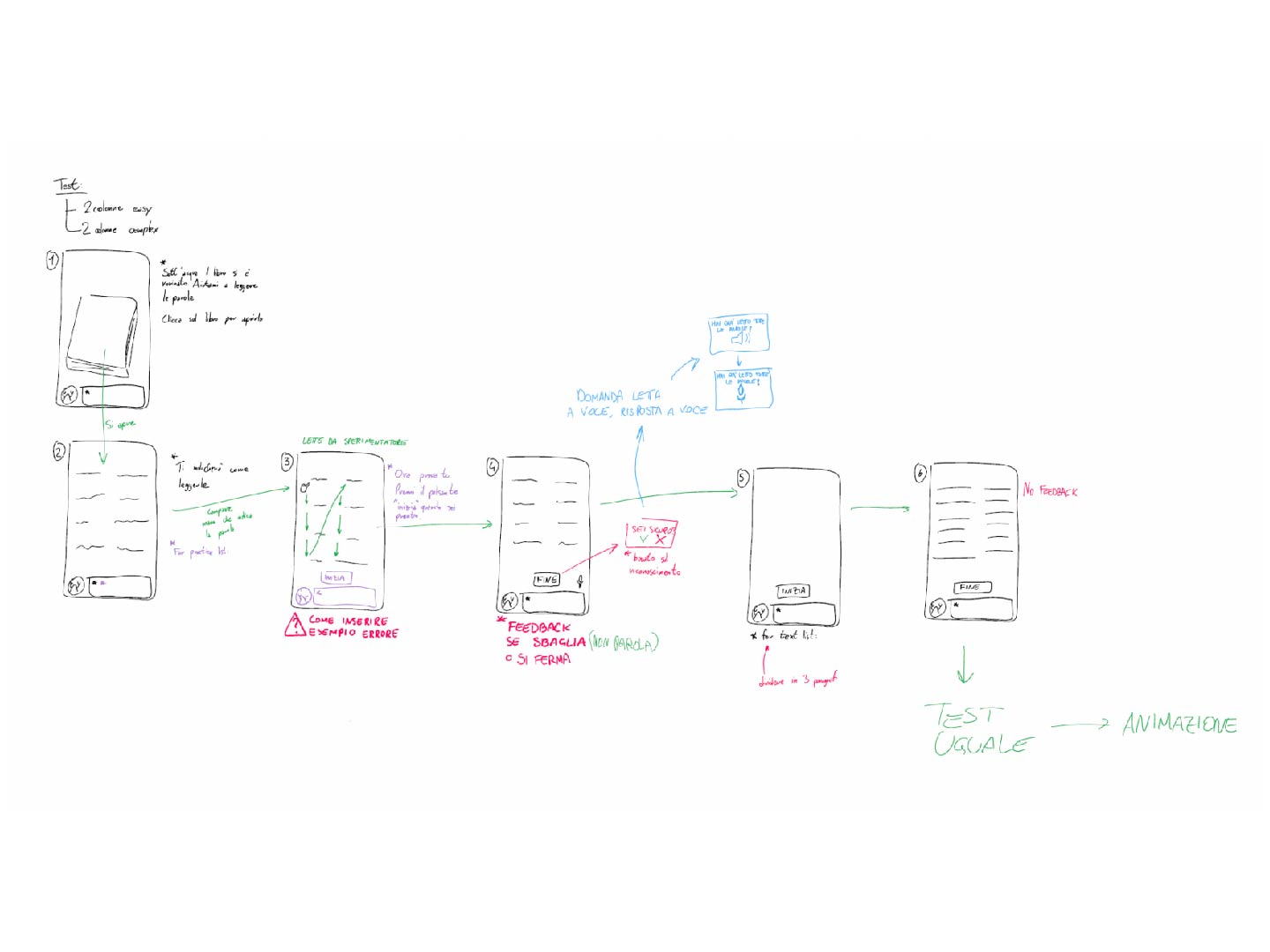
The experiment is divided into multiple steps.

Tutorial

Every time the child is asked to perform a new task (e.g. reading aloud), a tutorial session is provided. Every tutorial consists of an example of the actual task, which is firstly performed by the computer and secondly performed by the child.

Actual task

The final task is composed of different sets of stimuli which consist of lists of Italian words and pseudo-words administered to the subjects via a tablet.

Every task is recorded by the system, which saves:

1) reading time;
2) reading accuracy (if pronunced words corrispond to the presented ones).

Theoretically, the whole experiment runs while a real-time voice recognition system (RVR) actively monitoring the subjects’ performance is in place, which is not present in this prototype.

The whole interaction with the experimental setup takes place via a touch screen interface. The subject can navigate through the game and the tasks using the dialogue windows, buttons or images on the screen.

Errors managemet

Finally, if the subject correctly performs the given task, he is allowed to proceed forward, while if the RVR system detects an error during the test or the practice trials, the system asks the child to re-perform the task.

If the child is stuck in the task, the system automatically calls the experimenter, who can come and resolve the situation.

My contribution in Crab

I mostly focused on the storytelling of the application. I created some animations, using Adobe After Effect, that were displayed in specific key-points of the user flow.

These animations were designed to motivate the users (children) to successfully accomplish the tasks.