Online vs in-presence lectures: which one provides the best learning experience?

A qualitative research on learning experience during COVID-19 pandemic.

Project overview

Problems

Students’ learning experience seems to be badly affected by some learning modalities (especially during online lectures). How can we better understand these problems? In order to provide new possible solution, we need to build a grounded theory.

Methods

Qualitative research;

semi-structured interviews;

focus groups;

ethnographic observations;

personas;

workshops.

Tools

Audio recording;

Figma;

Cards;

Illustrator.

Goals

Better understanding which are the key hallmarks that underly successfull lectures, both in presence and online.

Developed in collaboration with Delaram Esfahani, Elena Mauri, Ignacio Aristondo, Laura Biondo, Miraxh Tereziu (2021).
Introduction

Covid-19 virus has become a ubiquitous thing in our daily lives, specially in education and our social life. A lot of things, regarding education, changed because of it and our interest increased towards understanding not only the way these changes happened, but especially the way it affected students and teachers' daily lives.

This is the reason why we decided to start our research on “a comparison between online and in-presence lectures” and this working process has taken over the last 4 months. The discovery project was done based on a sample of university students and all the research was conducted based on the same sample. We investigated the nature of this “new (not so new) reality” using the traditional methods of qualitative research (ie. observations, field notes, interviews, focus groups, and workshops, among others.)

We gained a lot of insightful data and we arrived to promising results that could be interesting to explore in future projects and assignments not only to find a solution but specially to find a way in which we can make an impact on education using the best of both realities (online and in-presence modalities).

“A problem well stated is a problem half solved” — Charles Kettering —

“What makes a successful lecture?” is the question that best defines our research, and it is exactly the target where we will focus this report in, because it is what gave a direction to this project. Without further details, let's start at the beginning of the road.

Research process

1

Framing the research questions

2

Fieldnotes, interviews, focus group

3

Design workshop

4

Qualitative coding

The problem

The aim of our research is to draw a comparison between online and in-presence learning, in an attempt to understand what makes a lecture successful.

From march 2020, each student experienced the transition from in-presence lectures to online classes: in a week, every matter related to university changed, and with it our way to experience it and our habits. We had to learn how to use online platforms for lectures (Zoom, Meet, etc.), to perform exams in front of a computer and to meet our colleagues mainly online. Now, almost 2 years afterwards, everything went back to how it used to be and is therefore the perfect time to understand what impact the change we experimented had on students, on their mental health and on their performance. While investigating these topics we focused our attention on the drawbacks and potentialities of the two learning modalities, on students experiences and on their opinions.

The topic we chose is one we were particularly interested in: as students, after disclosing our experiences and confronting them we saw that they were similar, that we suffered the same deficits, and in the attempt of making sense to what happened to us we decided to investigate the subject and deepen our understanding of the phenomenon.

Addressing the problem

We based our work on 3 different qualitative methods:

1) Observations (both virtual and in-presence);
2) Interviews;
3) Focus group.

1) Ethnographic observations

We made 30 observations in total, five per each member of the group. Two of those five observations were taken into place in presence and the other 3 were online.

For the in-presence observations we have observed both students and teachers. The observations were carried out during classes in Povo, Rovereto and Trento. The goal of these observations was to see students and teachers behavior, distractions, interactions, attitudes, and the environment that surrounded them.

With the online observations we analyzed forums, comments and posts (reddit, skuola.net, twitter, quora, facebook) and had instead the possibility to gain an understanding of students’ opinions, thoughts, feelings, personal experiences and insights mainly regarding online lectures and exams.

2) Semi-structured interviews

We conducted 12 interviews in total, both in presence and online, of students with experience of physical and online learning.

Our interview guideline touched all the topics of interest, namely:

Psychological factors,
Socialization,
Self management,
Tech issue,
Distractions,
Lecture hallmarks,
Student performances.

3) Focus group

For our focus group we contacted people through the Instagram page @spottedunitn and included our personal contacts.

Participants were, again, students with experience with on site and remote learning. The guideline was designed to address the problem from a different perspective: we asked the participants to draw a comparison between online and in-presence learning, we dived into the issue of mental health and delved into their personal experiences, thoughts and feelings.

What we learned

Among the different variables that we took into consideration while structuring our research, the majority of them emerged only in the first phases of the process and we therefore decided to focus on the 3 factors that remained central throughout the whole study.

What we found was in line with studies conducted worldwide (Arora et al., 2020; Elmer et al., 2020; Adnan et al., 2020;). These studies showed that online lectures, compared to in-presence lectures, seem to negatively affect mainly 3 factors:

1) psychological factors;
2) self management;
3) social interaction.

Final Ideation Workshop

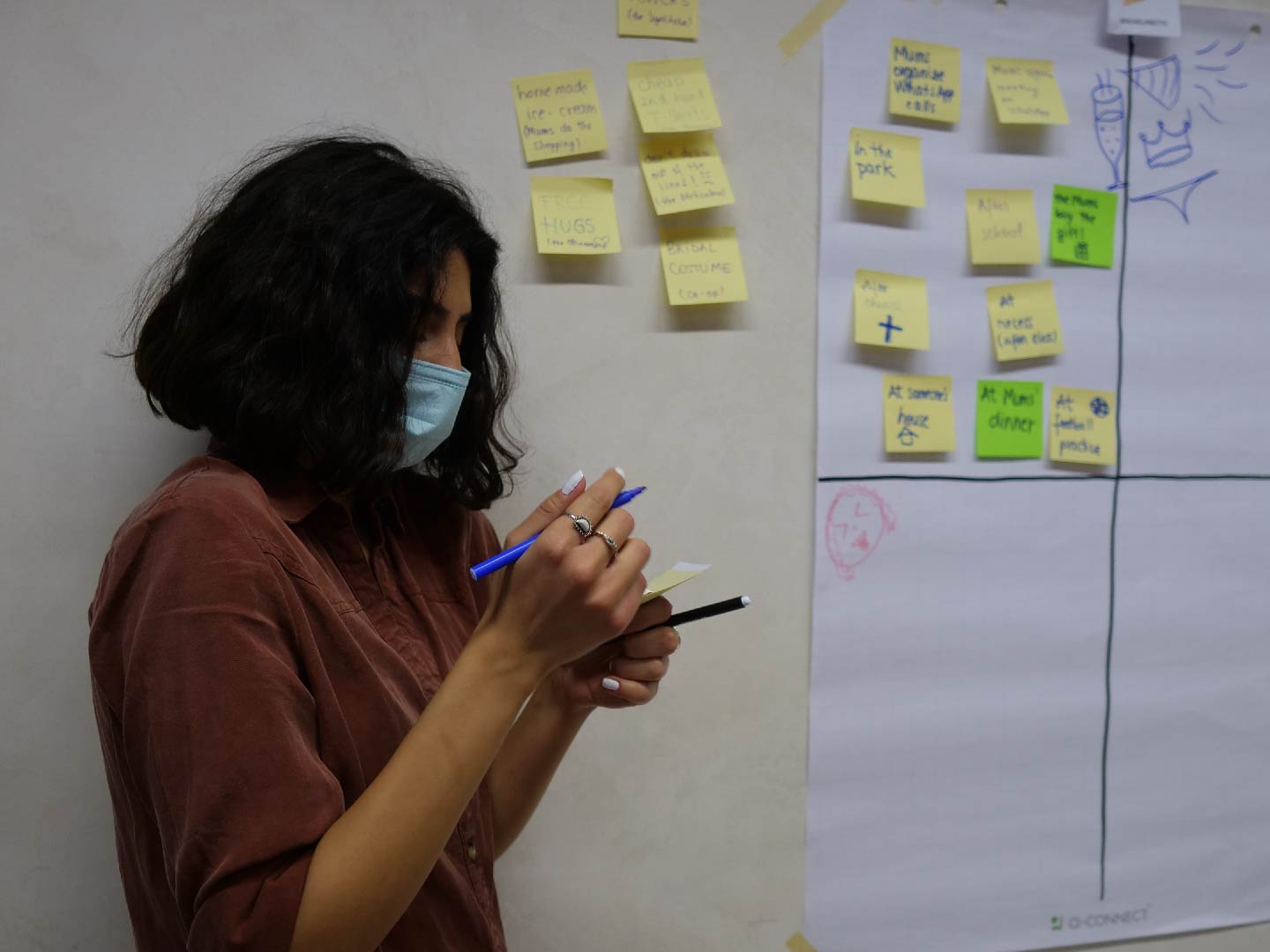
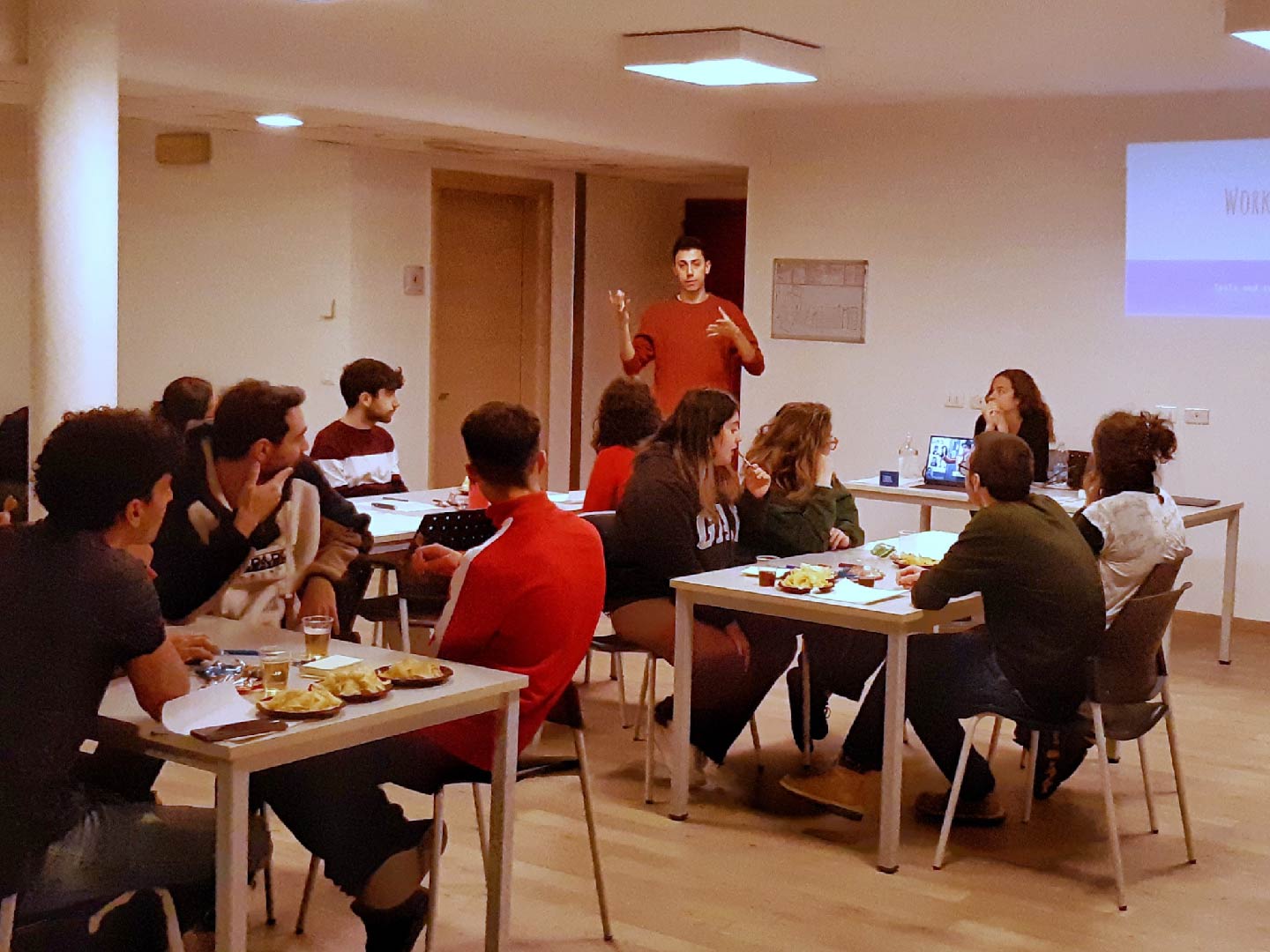
The last part of our research activity employed a design workshop. We agreed that the goal of the workshop was to find new ideas to improve the learning experience of students, addressing the issues that came up in the previous stages, namely psychological factors, social interaction, and self-management.

We built our workshop on the aim of preparing the perfect lesson so each activity constituted a step of the process to get to the aim.

Our participants divided spontaneously into groups by sitting down at each table: we had 3 groups, 2 made of 4 participants and a group made of 3. The workshop lasted 1 hour and a half in total.

We distributed the personas and scenarios (previously created) right after the first ice-breaking activity along with posters, post its and all the necessary material to perform the tasks required. For each activity, a maximum time of 10 minutes was provided.

In the end, each group had 5 minutes to review their ideas and decide the best ideas for each step. At the end of the 5 minutes they had to present their work as well as the process that got them to that result.

My role in this qualitative research

In this particular project, my background in Sociology became very handy. Indeed, I was able to help my teammates in framing the research question and structuring the interview guidelines.

Getting useful insights from qualitative data is always a challenging task, but eventually I was able to plan interviews, managing participants and moderating the focus group in an effective way.